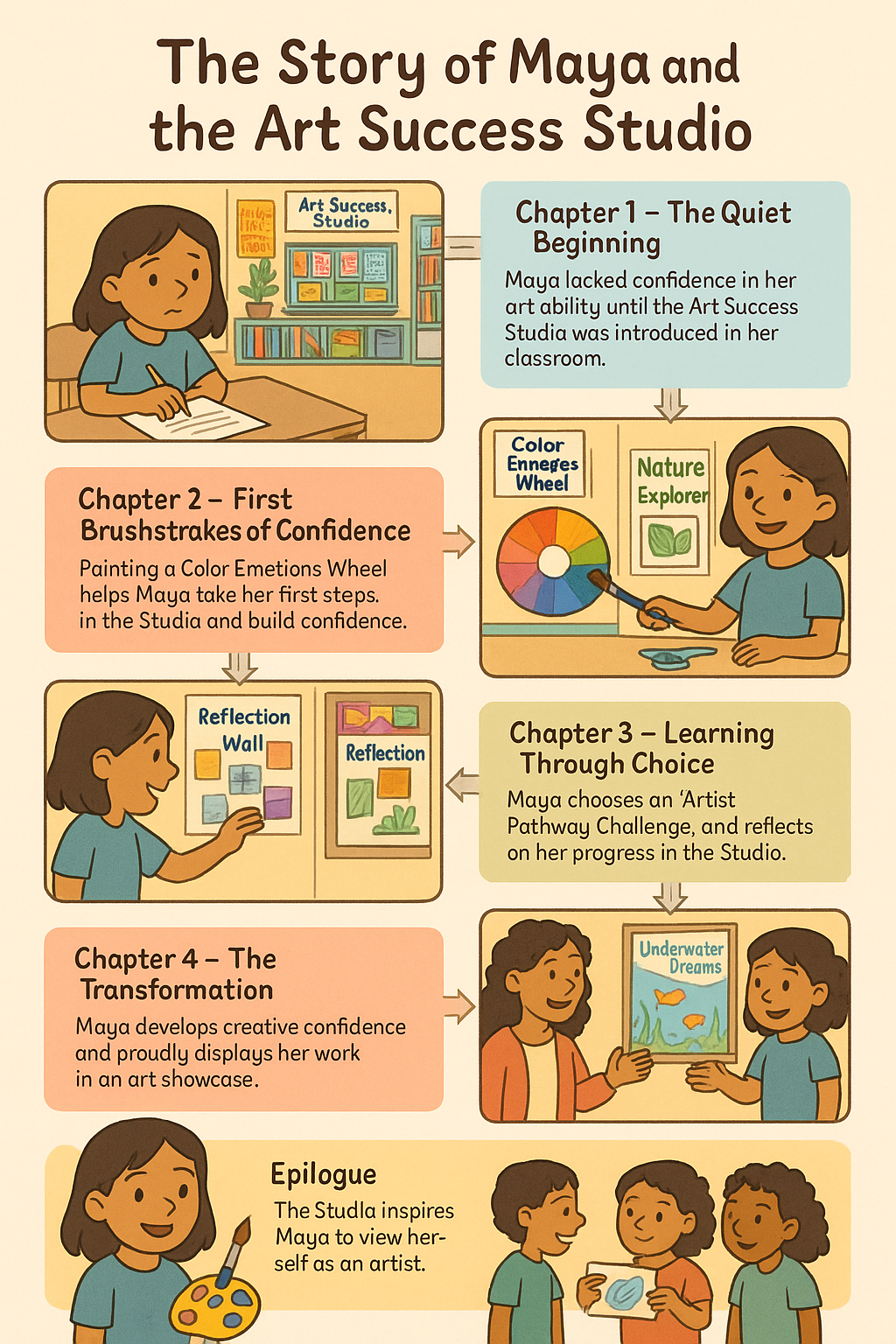
Art Success Studio began with a question: What happens to the student who can’t keep up in art class—but still has a creative voice waiting to be heard?
As an elementary art educator with 19 years of experience, I saw a recurring challenge—students with fine motor difficulties, attention issues, or behavior challenges were often left behind in the fast-paced, product-focused world of art instruction. Their creativity didn’t lack—they just needed time, structure, and support. But with large class sizes and limited time, how could I give them what they needed?
The design process started with empathy. I listened to teachers, special educators, and students. I observed patterns: frustration during unstructured tasks, meltdowns when projects got too hard, and a lack of confidence even when students had great ideas. I realized these learners didn’t need less art—they needed more art, presented differently.
So, I built Art Success Studio.
Overall View of Art Studio Success:
Goal
To equip art educators with effective classroom management strategies, creative engagement tools, and inclusive teaching practices that foster a thriving, organized, and inspiring art studio environment.
Mission Statement
Art Studio Success is dedicated to empowering art educators with the knowledge, resources, and confidence to create learning spaces where creativity flourishes and order is maintained. Through practical training, interactive scenarios, and innovative tools, we help teachers balance artistic freedom with structured classroom management—ensuring every student has the opportunity to explore, create, and succeed.
Vision Statement
We envision a world where every art classroom is a safe, organized, and joyful space—where teachers feel confident in their craft, students feel inspired to take creative risks, and art education is celebrated as a vital part of holistic learning.
Each phase of the intervention was intentionally crafted:
- Foundations to teach routines and hand skills
- Skills in Action to practice following steps with peer support
- Creative Confidence to give them a voice and choice
I created visuals using AI, wrote reflective scripts, and will be adding assessment tools. The final gallery walk will be about showing art and showing growth.
Art Success Studio is more than a plan—it is a proof of possibility. With the right tools and mindset, every child can thrive in the art room.
The Problem Art Success Studio Addresses
Elementary art classrooms are vibrant, creative spaces—but they are also fast-paced, multi-sensory environments that can present significant challenges for certain students. Among these are students with fine motor delays, attention difficulties, behavioral challenges, executive functioning deficits, and those who simply lack confidence in their artistic abilities. While most general education classrooms provide tiered academic interventions, the art room often lacks structured support systems tailored to student needs.
Without targeted support, struggling students may:
- Withdraw or avoid participation in art activities
- Display disruptive behaviors due to frustration or overwhelm
- Struggle with following multi-step directions or using materials safely
- Feel embarrassed by their work or compare themselves negatively to peers
- Miss out on key developmental benefits of art—such as self-expression, problem-solving, and fine motor coordination
These barriers not only limit students’ access to creative learning but also contribute to lower engagement, self-esteem, and inclusion in the art classroom. Teachers, in turn, are left with limited strategies to address these diverse needs while still managing full class sizes and complex lesson plans.
Art Success Studio was developed in direct response to this gap. It recognizes that every student deserves the opportunity to succeed in art, but some students need an intentional, structured pathway to get there. By offering a six-week, small-group intervention focused on skill-building, creative confidence, and positive behavior support, the program helps ensure that struggling students are not left behind—but rather, lifted up through art.
Analysis Details: The Backstory Behind the Art Success Studio Storyboard
The Art Success Studio storyboard was developed through a learner-centered design analysis process, guided by empathy, observation, and experience in diverse elementary art classrooms. The goal was to create a targeted intervention that would not only address gaps in student engagement and skill, but also reflect the real needs, personalities, and learning environments of those it was designed to serve.
Learning Environment Considerations
Elementary art teachers often teach hundreds of students a week across multiple grade levels. Classes are typically short (45-50 minutes), with limited time for individualized instruction. In these settings, students must transition quickly, follow complex routines, and complete projects using tools that require fine motor coordination—all while managing their emotions and social interactions.
Understanding the Learners
Observation and teacher input will hopefully reveal that many students who struggle in art class are not lacking creativity—they are overwhelmed by sensory input, fine motor expectations, or unstructured time. Some learners are perfectionists who fear making mistakes. Others are hyperactive, sensitive to noise, or unsure of how to express themselves visually.
💡 Motivations and Ambitions
Despite these challenges, students love art. It offers them a break from traditional academics, a chance to explore, and a space to shine. They are motivated by color, movement, praise, and peer attention. They want to be seen as capable artists, to create something meaningful, and to experience joy through the process.
Frustrations and Barriers
Frustration often arises when students are confused, rushed, or unable to complete a task. Common barriers include:
- Poor fine motor control
- Limited ability to sequence multi-step directions
- Fear of failure or being “wrong”
- Social anxiety or difficulty working in groups
These issues can lead to avoidance, disruptive behavior, or disengagement.
Desires and Emotional Needs
At their core, these learners want the same thing all students want: to feel safe, supported, and successful. They want their work to matter, their effort to be recognized, and their voice to be heard—visually and emotionally.
“Art speaks where words are unable to explain.”
— Unknown
 Crayons & Creativity